

Timber…
I was bright-eyed and bushy-tailed when I bought my house in 2021. The low interest rates were enticing, and I thought, “Yeah, I can handle the costs of homeownership!”
I imagined building equity and eventually reselling for a nice profit. I imagined caring for my yard. I imagined occasionally replacing an appliance or doing small renovation projects. I’ve now done all of the above (except for reselling).
I didn’t, however, imagine having to get two massive trees in my front yard—which were covered in kudzu, ivy, wisteria, and other vines—cut down.
I’ve helped fell a few trees in the past. I once had to hold a rope line as part of a tree-downing service project. But I always mourn when trees have to fall, because I care about the environment, it costs a lot of time and money to do, and trees are pretty to look at even when they’re dangerous.
My city has also been undergoing a massive growth spurt in the last decade or so, which means trees are getting ripped up en-masse all over the place to make way for new homes and offices (and now possibly even an AI data center just outside the city limits).
The whole scenario reminds me of the scenes from The Fellowship of the Ring and The Two Towers when the audience realizes that a wizard—who “should know better!”, in the words of an Ent named Treebeard—is cutting down precious swaths of semi-sentient forest in order to build an orc (sorry, Uruk-hai) army. J.R.R. Tolkien had a not-so-pretty view of what industrialization and the journey to modernity looked like. The image of a grey field of dead stumps shown in the Two Towers film is an accurate reflection of his feelings on the subject.
And now here I am, a homeowner who has to be responsible for cutting down two trees that were a danger to my house and nearby power lines. At least one of them likely existed before or around the time my house was built back in the 1950’s.
It was impressive to watch the company I hired dismantle the trees bit by bit.
Most companies in my area use big lift trucks and other heavy equipment. In my situation, though, due to accessibility issues, those weren’t viable options. The company I hired specializes in climbing, and the only heavy equipment they needed were a Bobcat/skid steer, a massive mulcher, and a big truck with a mechanical arm that could move huge logs onto its bed. Ropes hung down all over the place and connected from tree to tree. I watched as a man scaled my trees, lopped off their limbs with a chainsaw, and lowered the big branches to the ground using simple-machine techniques.
Impressive.
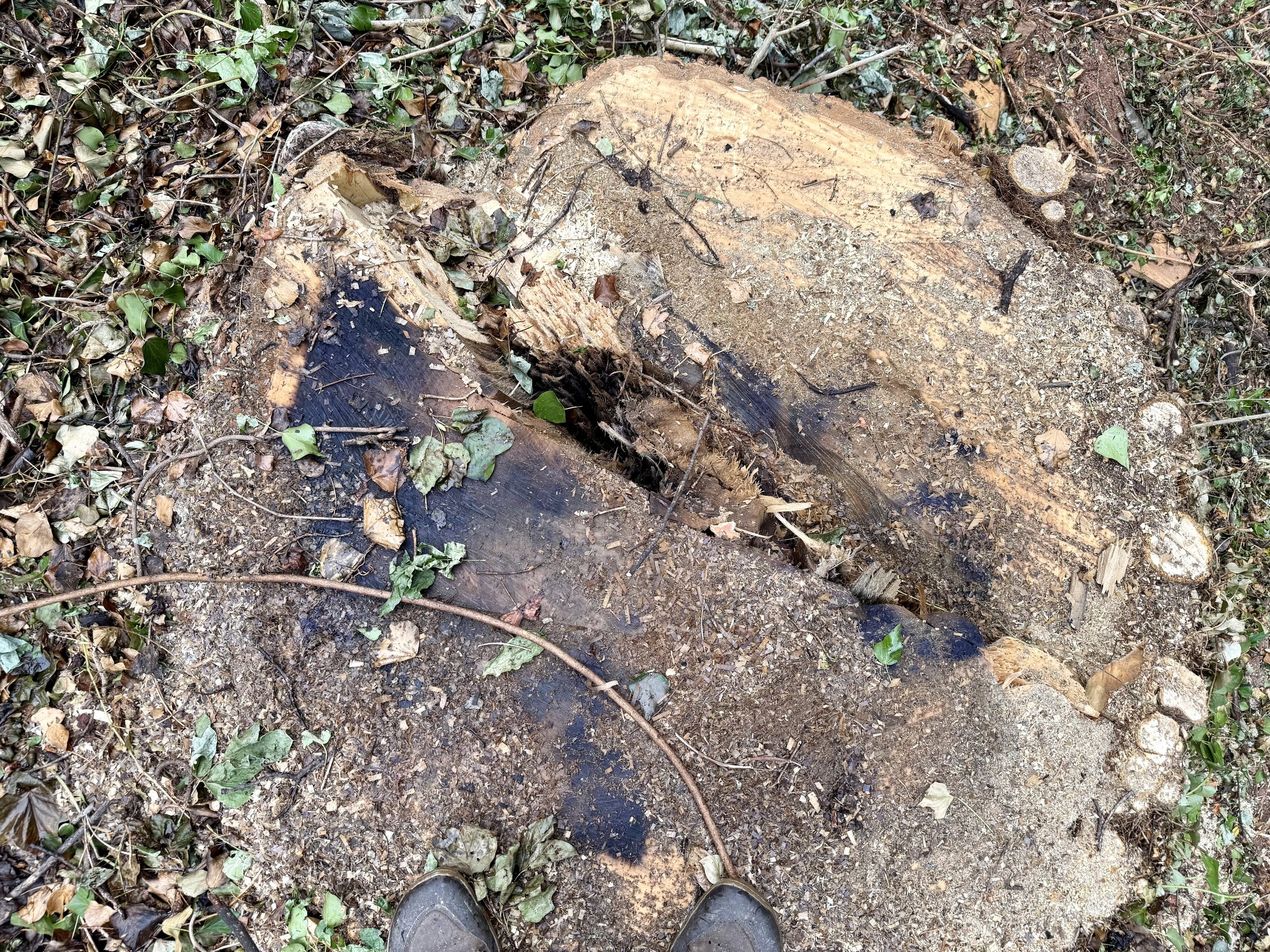
And sad. Though my sadness was slightly assuaged when the foreman told me both trees had big cracks and a lot of rot in their trunks. “You’re lucky,” he said. “Who knows how much longer they would’ve stood?”
Normally, people love to shout “Timberrrrr!” as a tree falls in the forest and does make a sound. But not me this past week as I watched branches, leaves, and limbs tumble to the ground to the hard, grinding music of chainsaws and a huge mulching machine.
Instead of an excited shout, as these trees went down with heavy thuds, I whispered, “Timber…”